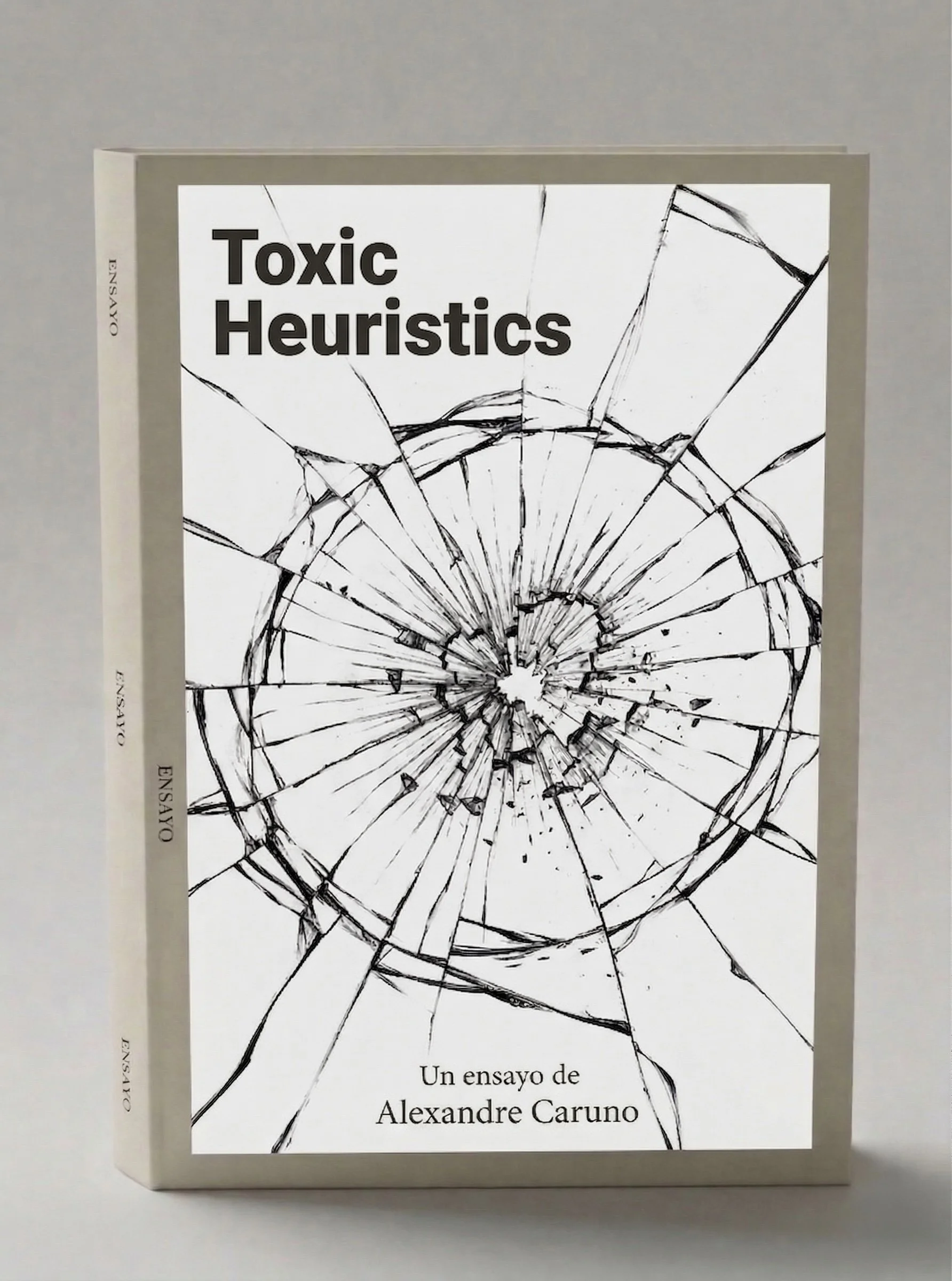
Toxic Heuristics
Fear is not a symptom, it´s an infrastructure. Within hierarchical societies, “power” does not ultimately seek to foster individual satisfaction —a sentiment as resolutely bourgeois as it is static and fragile—but rather a clinical steady drip of grief, carefully calibrated to keep the subject alert, active, and ultimately functional.
Fear, which in its biological reality was born as a tool against danger, operates today as a sedative to control the masses. Through the glow of our screens, we have become passive spectators of our own paralysis. A landscape where life devolves into bureaucracy, and fear is dispensed so that the individual dares not truly live their circumstance, falling victim to a relentless cognitive overflow. The first step towards freedom is to realize that this terror does not belong to us. It is a calculated piece of social engineering, sustained entirely by the invisible architecture of heuristics.
Psychologists use the word ‘heuristics’ to describe the shortcuts our minds take to arrive at quick answers without the labor of deeper thinking. We rarely even notice them. They push us to accept what is merely ‘reasonable’, forcing us to abandon any hope of perfection, a realm only left to the “old masters” in painting and deceased physicists and mathematicians.
Heuristics do not seek the ideal, only what is ‘good enough’. A category which, in art, we would label as mediocre, and in political life, serves as the absolute preamble to submission. Heuristics seduce us with velocity, but in exchange, they demand we surrender our capacity for attention.
In that act of watching without seeing (part of this economy of thought) the heuristic finds its most fertile fissure. They reduce the complexity of any decision, problem, or question by simplifying its world, erg ignoring most of the reality that is relevant around us.
In contrast, algorithms (those deterministic and emotionless) are engineered to arrive precisely at a terminal solution for any specific situation. It operates in a void of meaning; for it, data are merely 1s and 0s, blind to the nuances of human value. If you are baking a cake, following the recipe to the exact letter, that is an algorithm. Adjusting ingredients to taste through trial and error is a heuristic. Much like with cake, the use of heuristics can accidentally lead to a delicious outcome, but it is far more probable that it will simply burn the cake.
THIS IS A SAMPLE FROM THE ESSAY TOXIC HEURISTICS
KEEP READING @SUBSTACK
OR SUSCRIBE TO THE CHANEL HERE: https://carusowrites.substack.com
FORM EVERY DONATION YOU WILL RECEIVE THE PDF VERSION